
The phrase “such as” is commonly used to introduce examples in both spoken and written English. However, in more formal writing, there are several appropriate synonyms that can replace “such as” to enhance clarity and tone.
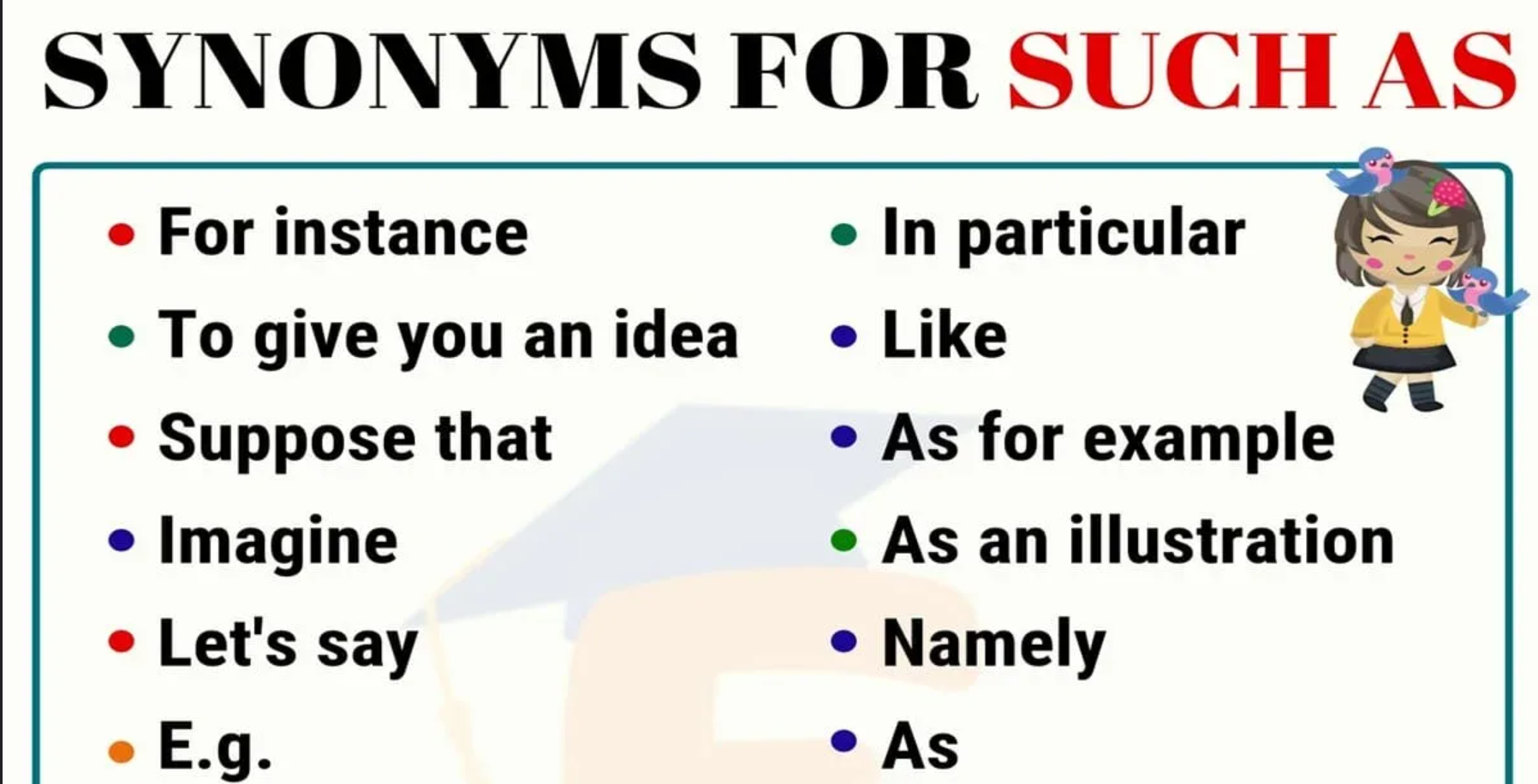
Top Formal Synonyms for “Such As”
- For example – A widely accepted formal alternative.
- For instance – Similar to “for example,” often interchangeable.
- Including – Suitable when listing partial elements of a whole.
- Namely – Used when specifically naming items.
- In particular – Emphasizes one or more notable examples.
- Among others – Implies more items not listed.
- To illustrate – Best used to lead into detailed examples.
Usage Examples in Formal Sentences
| Informal | Formal |
|---|---|
| We studied poets such as Wordsworth and Keats. | We studied poets, for example, Wordsworth and Keats. |
| Various tools such as hammers and screwdrivers were used. | Various tools, including hammers and screwdrivers, were used. |
| European countries such as France and Germany have strict laws. | European countries, namely France and Germany, have strict laws. |
Tips for Choosing the Right Synonym
- Use “for example” and “for instance” for general illustrative purposes.
- Choose “namely” when the examples define or narrow down a previous term.
- Opt for “including” when the list is partial, not exhaustive.
- Use “to illustrate” when expanding on a point with more detail.
Conclusion
Replacing “such as” with formal synonyms like “for example,” “namely,” or “including” can improve the professionalism of your writing. The best choice depends on the context and the specific role of the examples in your sentence.
FAQ
Is “such as” too informal for academic writing?
No, “such as” is acceptable in academic writing, but alternatives like “for example” or “namely” can be more precise and formal depending on context.
Can “including” always replace “such as”?
Not always. “Including” implies a partial list, while “such as” can be used for both partial and complete lists. Use it carefully to maintain meaning.
Which is more formal: “for instance” or “for example”?
Both are considered formal and are often used interchangeably in academic and professional writing.
 Name That Term
Leave a comment